Everything You've Ever Wondered About Handmade Wooden Spoons
Answers to the top 10 most asked questions I get — from wood sourcing and hand carving to dishwashers, staining, and why wooden spoons beat plastic.
COMMUNITY
3/31/20268 min read
People sometimes look at me a little funny when I tell them I’m a spoon carver.
I get it. It’s a little quirky.
But whether it’s at a farmers market or a dinner party, it turns out to be a great conversation starter—and once we get going, the questions usually keep coming.
This post is my attempt to answer those questions—the ones that come up most often, and what you should know if you’re thinking about buying—or lucky enough to already be using—a handmade wooden spoon.

Where does the wood come from?
Most of my wood comes from eastern Massachusetts and coastal Maine—cherry, maple, birch, beech, apple.
Sometimes it really is as simple as a text from a friend or neighbor after a storm—a big Maple limb down in someone’s yard, and I go take a look with my two golden retrievers, Coco and Phoebe, who consider this part of their job.
Other times it’s less dramatic. I’ll hear a tree crew working down the street and walk over to see what they’re taking down, or pick through fresh trimmings before they get chipped.
That’s more or less how it works!
What kind of wood do you use, and does it matter?
It matters more than most people expect—and it’s a big part of what you’re getting when you choose a handmade spoon.
Different hardwoods have different densities, grain patterns, and natural properties. That affects how a spoon feels in your hand, how it holds up over time, and how it looks after years of use. Over time, those differences are what turn a spoon from something you use into something you reach for without thinking.
Maple is my most abundant wood, and for good reason. It’s dense, durable, and pale enough to show off the natural figure in the grain.
But my favorites to carve are the fruit trees: cherry, apple, and pear. Their grain is tight and almost buttery under the knife. These woods also reward you over time—cherry deepens to a warm reddish-brown, apple polishes to an almost glassy smoothness, and pear has a subtle warmth that’s hard to find anywhere else.
I don’t use softwoods. Pine and cedar are relatively abundant here in New England, but are too porous for a kitchen tool—they won’t hold up or take on the kind of wear that makes a wooden spoon better over time.
Do you make these entirely by hand?
Mostly, yes—but I'll often use a bandsaw to rough out the profile from a blank after I split the logs I am working with. It’s faster, more consistent, and a lot easier on my body over a long day in the shop. The traditional approach is to use a carving axe, and I do work that way sometimes, but the bandsaw lets me start with a clean, precise shape.
Everything after that is hand work.
The shaping is done with a spokeshave and straight knife, the bowl with a hook knife, and the final surface comes directly from the blade. A sharp knife cuts the fibers cleanly, leaving a surface no sandpaper can replicate. I burnish every spoon with a smooth river rock, which closes the grain and brings out a natural luster.
From there, some pieces get additional decorative work—painting, inlay, chip carving, or engraving—all done by hand.
Everything is shaped and finished with hand tools, start to finish.
What you’re feeling when you run your thumb across the bowl is the direct result of a knife, a river rock, and a few hours of focused work.
How long does it take to make one spoon?
About two to three hours of hands-on carving time, depending on the piece—a straightforward cooking spoon on the faster end, a more complex piece with inlay or an unusual blank on the longer end.
But from log to finished spoon, the process takes closer to two to three weeks.
The wood is initially worked while it’s still green, then the spoon is left to air dry. After that comes any decorative work—painting, inlay, carving—followed by finishing with food safe oil and time for that finish to fully cure.
I mention this not to justify the price, but because it changes how you relate to something when you know how it was made.
A spoon that took hours to carve from a tree that grew for decades—and weeks to fully come together—is a different object than one that came off an assembly line.
Can I put it in the dishwasher?
No—on behalf of spoon carvers everywhere—please don’t!
The dishwasher is one of the fastest ways to ruin a wooden spoon—second only to letting my dog Phoebe get hold of it.
The combination of heat, steam, and harsh detergent basically cooks the wood—drying it out, raising the grain, and eventually leading to cracks or warping. Even one cycle can do real damage.
The good news: the alternative is easy.
Wash it by hand in warm water, dry it with a towel, and you’re done. Ten seconds of care, and your spoon will last for decades.
How do I take care of it so it lasts?
It’s simple. Two main things: don’t let it sit in water, and oil it when it looks dry.
Leaving a spoon soaking in the sink does the same kind of damage as the dishwasher—too much moisture, followed by drying, which leads to cracking over time. Wash it, dry it, and you’re done.
For oil, use a food-safe mineral oil or a butcher block oil. Avoid cooking oils like olive oil—they can go rancid inside the wood.
I make my own Spoon Butter—a blend of beeswax and food-safe oil—specifically for this.
With that kind of care, the spoon develops a deep, durable finish that only gets better with time.
Will it stain or wear out over time?
It might pick up a little color over time, especially with things like tomato sauce or spices. Lighter woods like maple show it more at first.
But with regular use and occasional oiling, the wood develops a natural patina that evens everything out. What starts as a faint stain becomes part of the overall character of the spoon.
More to the point: this is a tool that’s meant to be used.
The marks it picks up along the way—a bit of color here, a small nick from the edge of a pan—aren’t flaws. They’re what make it yours.
A spoon with some history to it isn’t worn out. It’s just getting better.
Is a wooden spoon actually safe to cook with?
Yes—and in some ways, it’s a better option than plastic.
Wood has a natural structure that doesn’t give bacteria the same kind of foothold that worn plastic does. Once plastic spoons get scratched up—and they all do—they can hold onto bacteria in ways that are harder to clean.
Wood also doesn’t shed microplastics into your food, which is an increasingly real concern with plastic utensils.
None of this means you should be careless. Wash your spoon well after using it with raw meat, and set it aside if it ever develops a deep crack.
But as an everyday cooking tool, a well-cared-for wooden spoon isn’t a compromise. It’s the better choice!
What's the difference between your collections — and which one should I get?
If you’ve spent any time in a kitchen, you know the feeling of having a favorite tool—the one you reach for without thinking. The pan that’s always on the stove. The knife that just fits your hand.
The goal with every spoon I make is to become that one for you: balanced right, sized for your pots, and natural enough that you reach for it without thinking.
The collections are just different starting points:
The Everyday Series is built for cooking. Solid, simple, and made to be used hard without a second thought.
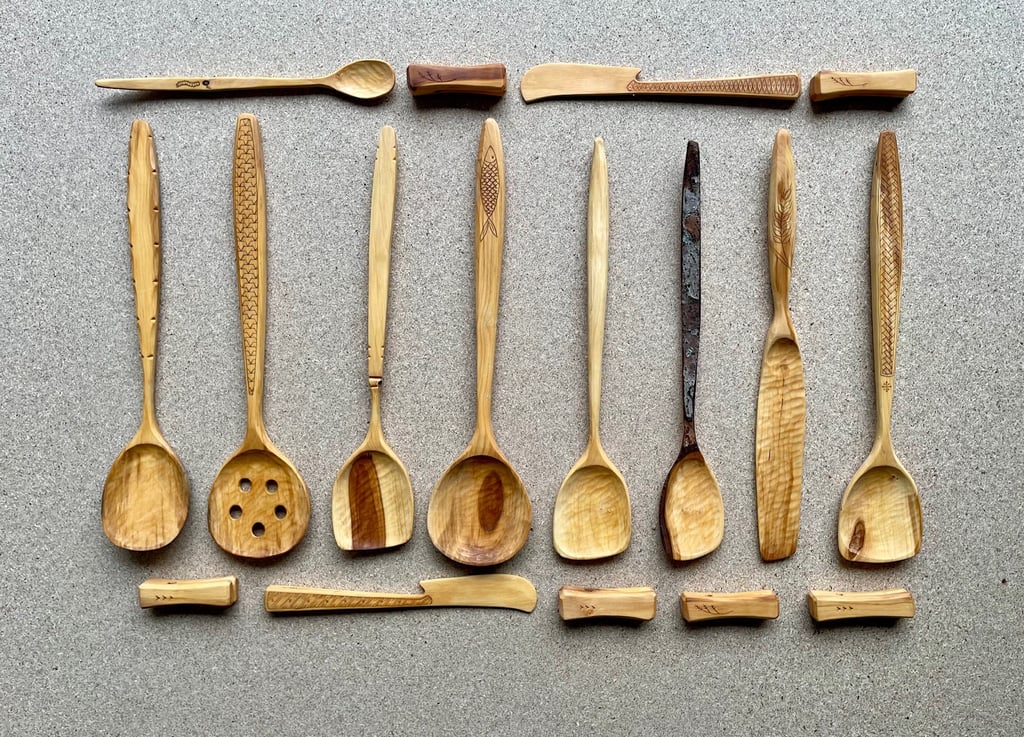
The Signature Series is a step up in refinement—more attention to form, more character in the wood, and unique decorative details. These are pieces that work hard and look good doing it, the ones that tend to live on the counter.
The Premium Collection is where I spend the most time per piece. Unusual blanks, inlay work, more complex carving. Each one is truly one of a kind.
If you’re not sure where to start, most people go with a cooking spoon from the Signature Series. It’s the right balance of function, feel, and unique presence—and it's a good place to start.
Why spoons — how did Spoonweather start?
The short version: COVID, a pile of storm-fallen wood, and a golden retriever named Coco.
I started carving during the lockdowns, mostly just to have something to do with my hands. I had access to a lot of fallen cherry and maple—New England storms had been generous—and I started making spoons.
Then I started giving them away.
Over the course of about a year, I gave away more than 250 of them—to neighbors, friends, strangers, people who needed something handmade during a time when everything felt a little impersonal.
Coco was there for all of it—on the wood-gathering walks, in the shop, generally keeping an eye on things. Phoebe came along a little later and has taken her role just as seriously.
Spoonweather became official when people started asking if they could buy one.
I said yes, and here we are!
















At the start, a handmade wooden spoon can feel like a bit of a question—how to use it, how to take care of it, whether it’s something you’ll actually reach for.
But it turns out not to be complicated.
You use it. You wash it. You oil it when it looks dry. And over time, it settles in—picks up a little color, fits your hand, earns its place on the counter.
What started as something you weren’t quite sure about becomes the one you reach for without thinking.
A tool like that isn’t something you replace. It’s something that earns its keep.
If you’re looking for your one, you can take a look at the featured collection below.
Spoonweather
Hand carved wooden spoons honoring local trees and community. Made in the USA .
© 2025. All rights reserved.
Learn more
Navigate
Connect


Needham, MA