Your Home Isn’t Missing More Things. It Might Be Missing Better Stories. (And What That Has to Do with Hand-Carved Wooden Spoons.)
Why do some objects in our homes feel meaningful while others simply fill a space? This reflection explores how the stories behind the things we use—from inherited tools to hand-carved wooden spoons and tree ring prints—can make a home feel more personal, authentic, and connected to the people and places we value.
BACKGROUND & HISTORY
8/7/20266 min read


Have you ever looked around your home and felt like something was missing, even though everything you need is already there?
Most of us are pretty good at filling a house. We buy a serving bowl because friends are coming over, replace the spatula that melted against the pan, find a lamp for an awkward corner, and gradually solve all the practical problems that come with living somewhere. None of those are bad decisions. But over enough years, it’s possible to look around and realize that a surprising number of the things surrounding us could have come from almost anywhere. They work and they look perfectly nice; they just don’t have much to do with us.
I wonder if that’s part of the reason a house can be completely furnished and still take a while to feel like home. The answer certainly isn’t to replace everything with objects that come with elaborate origin stories. Sometimes a spatula just needs to flip an egg. But I do think a home feels different when at least some of the things in it connect us to a person, a place, an experience, or something we value.
I’ve apparently felt this way for a long time, because I have a slightly odd habit when I’m standing in front of someone’s bookshelf: I wonder which books they’ve actually read. This isn’t a judgment—I have enough partially read books of my own to eliminate me from serving on that jury. I just find the shelves that have clearly been used much more interesting. There’s the cookbook that falls open to a favorite recipe, the field guide with a bent cover from being stuffed into a backpack, or the novel with a few passages marked to revisit. Those shelves tell you something about the person who lives there.
Over time, I realized I feel the same way about other objects. I have an old hammer in my workshop that my dad handed down to me. He used it to build the house our family lived in when I was first born, and all these years later I still reach for it in my own shop. There’s nothing especially remarkable about the hammer itself. I could go to the hardware store tomorrow and buy one that would probably be more comfortable to hold and drive a nail every bit as well. But I wouldn’t trade the old one for it. Every time I pick it up, there’s a connection to my dad, to that first family home, and to a part of my own history that a brand-new hammer could never replace.
The same can be true of a cast-iron skillet passed down from your grandmother, a bowl bought directly from a potter on a memorable trip, or a recipe box filled with handwritten cards that still comes out even though almost any recipe can now be found on a phone in ten seconds. The things we become attached to aren’t necessarily our nicest possessions. They’re often the ones that connect us to a particular person or place, or carry the marks of years spent actually using them.
And I think that gets closer to the heart of the problem. Most of us probably don’t need more stuff. We want our homes to feel more personal and less interchangeable. We want a sense of authenticity—the feeling that at least some of the things around us are there because they connect to who we are, where we’ve been, or what we value, rather than simply because they fill an empty space.
That realization has changed the way I think about carving spoons. When I first started, I was fascinated by the craft itself: learning to read the grain, experimenting with different woods, getting my knives sharp enough, and figuring out how to make a useful object with a few simple hand tools. I still love all of that. But after several years of carving and talking with the people who buy my work, I’ve realized that very few people come to me because they’re experiencing an urgent shortage of wooden spoons. Often, they’re looking for something more personal.
Recently, a woman asked me to carve a set of spoons for the strong women in her family. She wanted to give one to each of them, but she also wanted the spoons to represent their connection to one another. I carved them all from the same log, so every spoon had its own grain and character while still sharing the same origin. I then engraved everyone’s names onto each spoon as another small reminder of that connection.
The project had very little to do with finding a better way to stir soup. She was looking for a gift that represented something about her family, and the spoons gave her a useful way to express it. Over time, they’ll pick up scratches, darken with use, and become associated with meals and kitchens I’ll never see. That’s exactly what I hope happens.
A few years earlier, I carved another set of spoons that helped me understand this even more clearly. My wife’s aunt had to take down a beloved walnut tree in her backyard. Her kids had grown up with it, swinging from its branches and picking up the seemingly endless supply of walnuts it dropped every year. When the tree came down, she saved some of the wood and asked me to make spoons for her now-adult children.
I carved each spoon from that walnut and engraved the address of their family home on the handle. The value of those spoons had very little to do with my carving. The tree already had decades of family history attached to it. I simply helped turn some of that wood into something her kids could bring into their own homes and continue using.
Projects like these have changed what I think a handmade object can do. I can’t make something meaningful simply by carving it carefully or using beautiful wood. Meaning usually comes later, through use and familiarity. My job is to make something well enough—and give it enough of a story at the beginning—that it has a chance to earn a permanent place.
That’s also why I became interested in making tree ring prints. When I ink the cross-section of a tree and pull a print from it by hand, the pattern isn’t something I designed. It’s a record the tree has been creating for decades. An Eastern White Pine from Maine or an American chestnut from Massachusetts brings with it a real place, a real history, and years of growth preserved in its rings. The print gives you something more than an interesting pattern on a wall; it gives you a connection to a real tree and the place it came from.
I don’t think a personal home needs to be filled entirely with handmade things. Most of what we live with will always be practical, ordinary, and chosen because we needed it at the time. But there’s something different about the few objects that connect us to a person, a place, or a story. Those are often the things that stay.
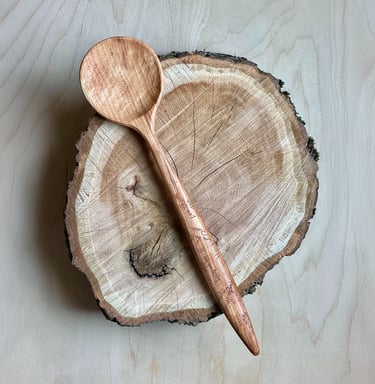
That’s what I hope my hand-carved wooden spoons and tree ring prints can become. Every piece starts with a local tree and a story you can actually know—whether it’s a maple that grew down the street, an apple tree from someone’s backyard, or a pine that stood in Maine for decades. With a spoon, you can literally hold that story in your hand and use it every day. With a tree ring print, you can see the years of a tree recorded in its rings and keep a small piece of that place in your home.
From there, the meaning is no longer mine to create. The spoon gets used, the print finds its place on a wall, and over time each becomes connected to someone else’s meals, routines, and memories. That’s when it has a chance to become more than something that simply fills a space.
That is ultimately what I hope Spoonweather offers: not more things for the sake of having them, but a few objects with enough authenticity, place, and story behind them that they have a chance to earn their place in your home. The best outcome is that years later, nobody is thinking very much about Spoonweather at all. They’re simply reaching for a favorite spoon or looking at a print on the wall and remembering the person, place, or story that gave it a reason to be there.


Have a story you'd like turned into a spoon?
Some commissions begin with a sketch. Others start with a memory, a favorite flower, or a person you want to honor. You don’t need to have it all figured out—just a sense of what matters most.
Spoonweather
Hand carved wooden spoons honoring local trees and community. Made in the USA .
© 2025. All rights reserved.
Learn more
Navigate
Connect
Needham, MA