The Ghost Tree in My Neighbor's Yard
The American chestnut once dominated the eastern forests — four billion trees, from Maine to Mississippi. A fungal blight wiped them out in a generation, but their roots are still alive underground, still sending up shoots that grow for a few years before dying back again. When a friend in Needham handed me a branch from one of these ghost trees, I carved it into spoons and learned the extraordinary story hiding in a very ordinary yard.
BACKGROUND & HISTORY
5/29/20266 min read


A few weeks ago, a friend in Needham handed me a branch and said, "I had to have a Chestnut tree in my yard trimmed. It is a very special tree. Can you make something from it?"
I said sure, the way I always do when someone offers me wood. I took it home, looked it over, and started reading about American Chestnut. And then I kept reading. What I found stopped me cold.
That branch wasn't just a piece of wood. It was a piece of one of the most remarkable — and devastating — stories in American natural history. And it had been growing quietly in a yard that hundreds of people drive past every single day.
A Tree That Built a Country
Before 1900, the American chestnut was everywhere. And I don't mean common — I mean dominant. One out of every four hardwood trees in the eastern forests was an American chestnut. The range stretched from Maine to Mississippi, from the Atlantic coast to the Ohio Valley. Billions of trees. Not millions. Billions.
They grew fast and they grew enormous — 100 feet tall, trunks five to eight feet across. The wood was straight-grained, light, strong, and naturally rot-resistant, which made it useful for just about everything. Fence posts. Railroad ties. Cabin logs. Barn beams. Furniture. Flooring. Shingles. Telephone poles. In Appalachia, people called it a cradle-to-grave tree — your crib was made of chestnut, and so was your coffin, and most of what you used in between.
And then there were the nuts. Every fall, chestnuts dropped in such quantities that people shoveled them off the ground. They fattened hogs and cattle for market. They fed deer, bears, turkeys, and squirrels. Late-19th-century newspapers ran stories about railroad cars overflowing with chestnuts heading to cities to be sold fresh or roasted. "Chestnuts roasting on an open fire" wasn't a quaint image for the holidays — it was an actual, everyday thing.
The American chestnut was, by almost any measure, the most important tree on the eastern half of the continent.
What Happened
Around 1904, a forester at the Bronx Zoo noticed something wrong with the chestnut trees on the grounds. The bark was cracking and blistering. The branches were dying. Within a year, the disease was showing up across the New York area, and it was spreading fast.
The culprit was a fungus called Cryphonectria parasitica that had come over on Japanese chestnut trees imported by American nurseries. Japanese and Chinese chestnuts had evolved alongside this fungus for thousands of years and developed resistance to it. The American chestnut had no such defense and became a sitting duck.
The fungus attacked the bark, girdling trunks and branches — essentially strangling the tree by cutting off the flow of nutrients. It spread by wind-borne spores. There was no stopping it.
By 1940, it was essentially over. In roughly 40 years, the blight killed an estimated 3.5 to 4 billion American chestnut trees. The dominant tree of the eastern forest was functionally extinct.
Let that number settle in. Four billion trees. Gone in a generation.
The Ghost
Here's the part that got me.
The American chestnut isn't technically dead. The blight kills everything above ground — the trunk, the branches, the canopy. But it can't kill the roots. The fungus can't compete with the microorganisms in the soil, so the root systems survive underground, sometimes for decades.
And they keep trying. The roots send up new shoots — sprouts that grow vigorously for a few years, sometimes reaching 10 or 15 feet, before the blight finds them again and kills them back to the ground. Then the roots send up more. This cycle — growth, infection, death, regrowth — has been repeating for over a century.
That's why people call it a ghost tree. The organism is still alive, still fighting, but it can never become what it once was. There are an estimated 400 million of these sprouts across the eastern U.S. right now. Living root systems sending up shoots that are doomed before they start.
The tree in my friend's yard in here in Needham, MA is part of this story. A living remnant of something that used to cover the continent. The small branches it produces — like the one she gave me — are the tree's latest attempt to come back. They'll grow for a while. Then they won't. The log she gave me made it 10 years before it lost its battle.
Carving It
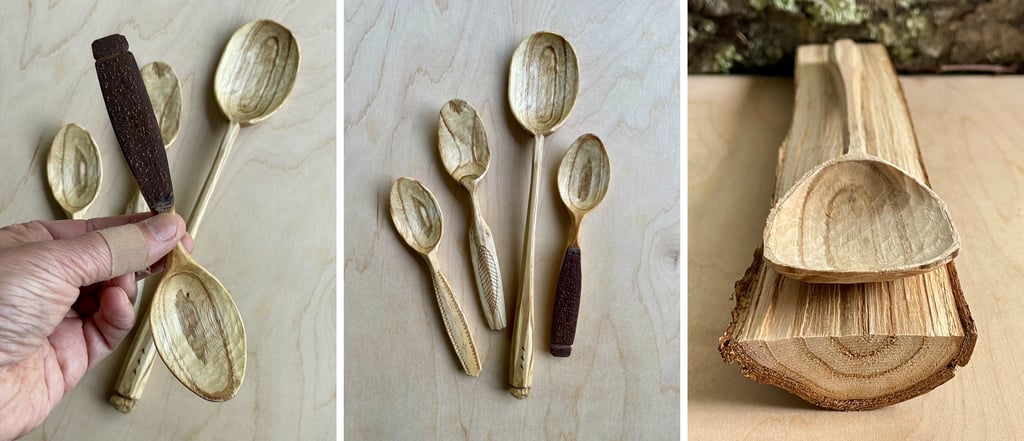
First thing I did was carve a couple of spoons for my friend as a thank you for the wood. After that, I got a few small cooking spoons and a few eating spoons out of what was left. The logs weren't large, so I couldn't get a ton. Like all the logs I carve, you take what the wood gives you.
One unique thing about Chestnut is that it is ring-porous. Each growth ring has a band of open, porous earlywood (spring) and a denser band of late wood (summer), which gives it a pronounced grain pattern — warm and honey-colored, noticeably different from the maples and cherries I usually work with. It's light for a hardwood and it carves cleanly, though you have to pay attention to those porous layers. The knife wants to dig in if you're not careful.
What made this different from anything else on my bench was simple: I had never carved chestnut before. I had never even come across fresh American chestnut wood or knew that was possible. I walk past maples, beeches, and fruit trees every day in the neighborhood. Those are my usual woods. This was something else entirely — fresh growth from a tree that has been trying to come back for over a hundred years.
What's Being Done
The story doesn't end with the blight. People have been working to bring the American chestnut back since the 1930s. The American Chestnut Foundation, founded in 1983, has been running a decades-long breeding program — crossing American chestnuts with blight-resistant Chinese chestnuts, then backcrossing over multiple generations to produce trees that are genetically almost entirely American but carry enough resistance to survive.
Scientists at SUNY's College of Environmental Science and Forestry took a different approach — inserting a single gene from wheat into the American chestnut genome that helps the tree break down the acid the blight fungus uses to attack it. If approved for release, it would be the first genetically modified forest tree planted in the wild in the U.S.
It's slow, painstaking work. But there are people who have devoted their entire careers to it, and they're making progress.
What's Right in Front of Us
I think about that tree in Needham a lot now. It stands in a regular yard on a regular street. Cars go by. People walk their dogs. Nobody stops. Most people probably don't know what they're looking at. I didn't, until someone handed me a branch.
That's the thing I keep coming back to. There are remarkable stories all around us — in the trees we pass, the wood we touch, the quiet corners of our own neighborhoods. You just have to slow down enough to notice.
I work with storm-fallen wood. That's always been the Spoonweather way — I carve what the weather brings down. But this was different. This wasn't a storm. This was something much bigger and much older handing me a small piece of itself. And the best thing I could think to do was turn it into something useful, something that would be held and used every day, and let the wood keep going a little longer to tell its amazing story.
Do you want to be part of the story?
100% of profits from the purchase of any of the American Chestnut items below will go to The American Chestnut Foundation and, in honor of my friend, to The Needham Community Farm.
Help bring back this iconic American tree, as well as fight food insecurity in our local community!


Spoonweather
Hand carved wooden spoons honoring local trees and community. Made in the USA .
© 2025. All rights reserved.
Learn more
Navigate
Connect

Needham, MA